

 New Horizons
 Project Management Academy
 Six Sigma Online
 TCM Security
 TRACOM
 Velopi
 Watermark Learning
 Login
Login



Staying competitive in business is partly about speed and precision. But how do you achieve both without sacrificing one for the other? Enter an unlikely duo: Six Sigma and Scrum.
Six Sigma, the data-driven perfectionist, focuses on eliminating defects and ensuring quality. Scrum, the adaptable project management methodology, emphasizes flexibility and quick iterations. At first glance, they seem like oil and water. But what if combining them could create a methodology that’s greater than the sum of its parts?
In this article, we’ll dive deep into how integrating Six Sigma’s structured approach with Scrum’s flexibility can offer a powerful hybrid methodology for various industries.
Key Takeaways:
- Scrum and Six Sigma can be integrated to enhance both productivity and quality. Scrum provides agility and quick iterations, while Six Sigma offers data-driven quality improvement.
- This integrated approach is particularly effective in software development, cross-functional team collaboration, customer feedback loops, lean agile environments, and agile transformations.
- While combining these methodologies offers numerous benefits, it also presents challenges such as balancing speed with quality, implementation complexity, and the need for additional training. However, with the right tools and approach, these challenges can be overcome.
Understanding Scrum
Think of Scrum as the agile athlete of project management – quick, flexible, and always ready to adapt. This lightweight methodology breaks down complex projects into manageable sprints, typically 1-4 week bursts of focused activity. It’s like tackling a marathon one mile at a time, with the ability to change your route as needed. Scrum thrives on communication, with daily stand-ups keeping everyone in sync, much like a well-oiled relay team passing the baton.
But Scrum isn’t just about speed – it’s about getting smarter with each lap. After every sprint, teams hold a retrospective to assess what worked, what didn’t, and how to improve. This continuous feedback loop, coupled with the methodology’s emphasis on collaboration, allows teams to pivot quickly in response to new information or changing requirements.
Key roles in a Scrum team include the product owner, the scrum master, and the development team.
- Product Owners manage the product backlog (an ordered list of items to complete).
- Scrum Masters facilitate the scrum process, coach the team in Scrum practices, and act as a bridge between the product owner and the development team.
- Development Teams design, develop, and test the product. They are typically self-organized and have three to nine members: developers, technical and business analysts, solution architects, and IT operations.
The Scrum process consists of:
- Sprint Planning: Involves all scrum roles in a 1-2-hour meeting to set goals, address concerns, and prioritize tasks for the sprint, ensuring the workload is appropriate.
- Daily Scrums: Quick, 15-minute meetings held each morning where team members discuss what they completed the previous day, their current tasks, and any obstacles.
- Sprint Review: At the end of a sprint, the team presents completed work to stakeholders to gather feedback and validate or adjust the product backlog. This stage includes all Scrum roles and stakeholders, and the duration varies based on the demo.
- Sprint Retrospectives: These are one-hour post-sprint meetings focused on reflection and improvement. The team discusses what worked, what didn’t, and plans for changes.
- Product Backlog Refinement: At the end of each sprint, the team and product owner refine the backlog to prepare for the next sprint, clarifying details and addressing scenarios without fully resolving them.
Effective Scrums have a clear objective and agenda, are time-boxed and efficient, facilitate open and effective communication, and encourage full team engagement.
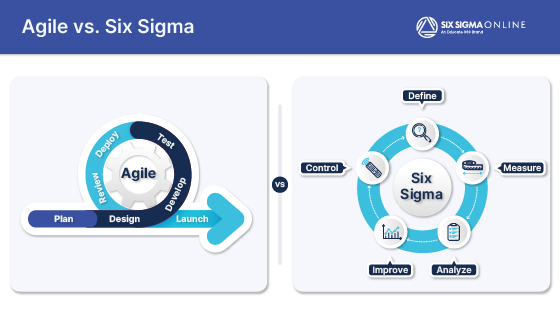
Understanding Six Sigma
Six Sigma is the sharpshooter of quality improvement methodologies. This data-driven approach aims to minimize defects and variations in processes, from manufacturing to product development. At its core, Six Sigma uses statistical methods to help organizational leaders understand their processes inside and out.
By diving deep into the data, Six Sigma identifies inefficiencies that might otherwise slip through the cracks and even predicts future performance. While it’s not specifically a project management approach, its principles are invaluable for enhancing quality and efficiency in project delivery. Organizations using Six Sigma can expect more consistent outcomes and a clearer picture of their operations. It’s about making informed decisions based on hard data, not gut feelings, ultimately leading to smoother processes and better products.
When combined with Lean principles in the form of Lean Six Sigma, this methodology becomes even more powerful, focusing not only on reducing defects but also on eliminating waste and streamlining processes for maximum efficiency.
There are three key roles in Six Sigma:
- Champions are senior leaders who sponsor and support Six Sigma projects, ensuring they align with business goals, providing resources, and removing obstacles to drive quality improvements and efficiency.
- Black Belts are team leaders who organize project tasks, oversee work, guide the team, and drive project success.
- Green Belts are leaders in smaller projects and data analysis. They use data-driven decision-making and cross-functional collaboration to ensure continuous learning and development within teams.
Six Sigma also includes Yellow Belts, who actively participate in projects, and White Belts, who are in the initial training phase, learning the fundamentals. To learn more about Six Sigma, check out our blog post, What is Six Sigma?
Comparing Six Sigma vs Scrum
When it comes to improving business processes, Scrum and Six Sigma stand out as two influential methodologies, each with its own unique approach to achieving excellence.
Scrum is an Agile project management framework that excels in complex, people-centered environments where requirements are often unclear or rapidly changing. It’s particularly popular in software development. Scrum operates through short, focused sprints, typically lasting 1-4 weeks. These rapid, product-oriented iterations allow teams to mitigate risks and foster continuous improvement. It’s a flexible approach that embraces uncertainty and allows for quick course corrections.
Six Sigma, on the other hand, is a data-driven quality management methodology designed to enhance efficiency, quality, and revenue across entire business systems. It uses statistical methods to identify and reduce defects and variability in processes. Six Sigma projects often span longer periods and focus on systematic, long-term improvements. This methodology is like a fine-toothed comb, meticulously analyzing processes to find and eliminate inefficiencies.
Understanding the distinctions between these two approaches is crucial for organizations looking to optimize their operations:
- Approach: Scrum emphasizes flexibility and quick iterations, while Six Sigma relies on data-driven, methodical improvements.
- Life Cycle: Scrum works in short sprints, whereas Six Sigma projects typically have longer durations.
- Adaptability: Scrum can quickly adapt to new information, while Six Sigma focuses on long-term, systematic change.
Below is a table that provides a more detailed breakdown of Scrum and Six Sigma’s approaches, life cycles, and adaptability.
| Scrum | Six Sigma | |
| Approach | -Focuses on the team -Uses iterative planning and short-term delivery to deliver value through prioritization consistently | -Focuses on individual performance Focuses eliminating significant causes of defect to ensure continuous improvement |
| Life Cycle | -Consists of sequential sprints, which are 2-4 week focused work period | -Consists of the DMAIC method |
| Adaptability | -Ability to shift focus regardless of the project’s current sprint -Accommodates changes or new requirements | -Focus on continuous improvement through quality control -Adapts to changes in processes |
Integrating Scrum and Six Sigma
Blending Scrum and Six Sigma offers organizations a potent toolkit for enhancing both productivity and quality. This integration isn’t about choosing one methodology over the other, but rather leveraging the strengths of each to create a more robust approach to process improvement.
Here are key areas where this combination proves particularly effective:
- Software Development: Imagine using Six Sigma’s data-driven approach to squash bugs while Scrum keeps your team agile. You’re not just coding faster; you’re coding smarter.
- Cross-functional Teams: When you’ve got marketing, design, and tech all in one room, this combo can help streamline communication and workflows, ensuring everyone’s on the same page and firing on all cylinders.
- Customer Feedback Loops: Scrum’s sprint reviews meet Six Sigma’s data analysis. The result? You’re not just listening to your customers; you’re understanding them on a whole new level.
- Lean Agile Environments: Six Sigma’s waste reduction principles can take your already-efficient Agile processes and make them even leaner.
- Agile Transformation: For companies making the leap to Agile, Six Sigma can provide the metrics and structure to ensure your transformation is on track and continuously improving.
Using Six Sigma in a Scrum environment helps remove waste and eliminate or reduce defects. Examples of why organizations might integrate Scrum and Six Sigma are:
- Define quality metrics in Scrum sprints
- Use Six Sigma tools for root cause analysis in Sprint Retrospectives
- Incorporate control charts in Daily Stand-Ups
- Apply Six Sigma’s DMAIC to improve the Scrum process
- Continuously improve projects within a Scrum methodology
Benefits of Integrating Scrum and Six Sigma
Because Six Sigma focuses on process control, standardization, and data analysis to detect and fix problems, combining it with Scrum helps organizations and teams improve project management, training, and process improvement. Some benefits of integrating Scrum and Six Sigma are:
- Enhanced process efficiency
- Improved product quality
- Data-driven decision making
- Increased customer satisfaction
- Risk mitigation
- Enhanced team collaboration
- Enhanced value delivery
By integrating Scrum’s agility with Six Sigma’s focus on quality and efficiency, organizations can drive continuous improvement, deliver high-quality products, and align closely with customer and business needs.
Challenges of Integrating Scrum and Six Sigma
Combining Scrum and Six Sigma can be beneficial but challenging due to their different focuses and methodologies. Six Sigma’s structured approach often faces resistance when integrated with the flexible Scrum methodology.
Below is a breakdown of five common challenges and considerations when integrating Scrum and Six Sigma.
| Challenge | Consideration | |
| Cultural Differences | Scrum promotes flexibility and adaptability, while Six Sigma emphasizes structure and precision. These cultures can clash if teams are not accustomed to one of the methods. | Foster a culture that values agility and quality. Train and coach teams to appreciate the strengths of both methodologies and create an environment that supports iterative learning and improvement. |
| Balancing Speed with Quality | Scrum is fast-paced and iterative, while Six Sigma processes may need to slow down due to their focus on reducing variation and defects, which can lengthen the project timeline. | To find the right balance between speed and quality, teams should carefully choose which Six Sigma tools to apply within a sprint that complements the agile workflow and establish clear criteria for when to prioritize quality improvement over rapid delivery. |
| Complexity in Implementation | Teams may struggle to add Six Sigma’s structured methodologies (like DMAIC) into Scrum’s fluid and iterative cycles. | Integration should begin small, carefully selecting Six Sigma tools that add the most value, such as defect reduction or efficiency improvement. |
| Training and Skills Requirement | Scrum masters and developers may not be familiar with Six Sigma methodologies, and Green Belts or Black Belts may not be adept in agile practices. | Invest in cross-training for team members. Consider having Black Belts or Green Belts work closely with Scrum team members to mentor them on integrating Six Sigma tools in an agile context. |
| Measurement and Metrics Alignment | Scrum focuses on quality feedback and velocity metrics, whereas Six Sigma focuses on precise metrics and data analysis. | Establish a common set of metrics that satisfy Scrum’s need for speed and Six Sigma’s need for precision. For example, Six Sigma can improve processes tracked in Scrum. |
Carefully considering these challenges and taking a strategic approach to the considerations can help organizations take advantage of the strengths of Scrum and Six Sigma, leading to more efficient, high-quality outcomes.
Rethinking Six Sigma for Scrum
Six Sigma provides a philosophy and structured methodology for problem-solving and process improvement, which can be applied to Agile environments and Scrum Sprints.
Integrating Six Sigma in Scrum involves asking stakeholders the right questions to address the right problems. For instance, during the Sprint Planning phase, consider incorporating Six Sigma principles by asking, “What processes are prone to errors or inefficiencies in our current workflow?” or “Where do we see the most waste or unnecessary steps in our Sprint cycle?”
These questions help identify areas where Six Sigma’s focus on reducing waste and eliminating defects can be most beneficial. Another example is during the Sprint Retrospective. You might ask, “Which defects or issues caused the most delays in our recent Sprint, and how can we apply Six Sigma tools to prevent them in the future?”
Organizations can enhance the quality and speed of their Agile processes by shifting the focus from simply reducing variation to actively eliminating waste and defects.
Case Studies and Examples
When integrating Six Sigma and Scrum, organizations can leverage the strengths of both methodologies to drive efficiency, improve quality, and achieve business goals. The following are a few case studies of organizations successfully integrating Six Sigma and Scrum.
- Motorola Solutions: Streamlining Software Development
- Motorola integrated Six Sigma with Scrum in its software development projects to manage iterative development cycles and monitor and improve software quality. The integration led to a significant reduction in defect rates in software products and the achievement of balance and speed for faster releases without compromising the integrity of the products.
- General Electric (GE): Enhancing Agile Project Development
- GE adopted Scrum in its IT projects to better manage software development’s complexities and fast-paced nature. They focused on the define and measure phases of DMAIC to ensure each sprint aligned with the broader quality goals. They also used the FMEA tool in the sprint planning phase to anticipate and mitigate risks. GE saw a reduction in the number of defects and reworks after sprints, as well as an increase in customer satisfaction.
These case studies show how integrating Six Sigma’s data-driven decision-making and quality focus with Scrum’s flexibility and iterative approach can help organizations improve process efficiency, product quality, and customer satisfaction.
Tools and Resources
Many complementary tools are available to help ensure a smooth integration of Six Sigma and Scrum. Such tools help to facilitate efficient project management, quality control, and continuous improvement. Below is a table of some of the most common tools and how to use them in the integration process.
| Tool | Purpose | Integration Use | Example |
| Jira | Project management tool for Scrum. | Can be customized to include Six Sigma processes (like DMAIC). | Track Scrum sprints while incorporating Six Sigma’s quality metrics and improvement plans. Plugins can be added to monitor Six Sigma’s KPIs (like defect rates and process efficiency). |
| Minitab | Statistical software tool in Six Sigma. | Can be used alongside Scrum tools to analyze data collected in sprints. | Collect data such as performance metrics and defect rates; the insights gained can then inform sprint retrospectives and planning sessions. |
| Trello | Visual project management tool in Agile environments. | Can manage Scrum tasks and include labels for Six Sigma tools (like SIPOC diagrams). | Visually track process improvements and monitor quality metrics throughout the sprints. |
| Smartsheet | Collaborative work management tool that supports project planning, tracking, and reporting. | Can manage Scrum projects while embedding Six Sigma methodologies. | Create custom dashboards, track DMAIC phases, monitor key quality indicators, and facilitate collaborative problem-solving using Six Sigma tools. |
| Asana | Work management platform that supports task tracking and project management in Agile environments. | Create workflows that incorporate quality checks and improvement cycles within the Scrum process. | Manage daily Scrum tasks and Six Sigma initiatives, such as process optimization and defect reduction. |
When used effectively, tools such as these allow organizations to benefit from the strengths of Six Sigma and Scrum.
If you want to enhance your Six Sigma or Scrum skills, start training today to become certified as a Green Belt or Black Belt or a Scrum Master or Product Owner.
Conclusion
The bottom line? Don’t put all your eggs in one methodology basket. This Scrum-Six Sigma blend could be your secret weapon. Whether you’re in software, manufacturing, or product management, it’s time to think outside the box. In business, the most potent solutions often come from unexpected pairings.
The key is to rethink Six Sigma through a Scrum lens. By focusing on eliminating waste and squashing defects within Scrum’s sprint methodology, organizations can unlock a treasure trove of benefits. It’s about using Six Sigma’s powerful tools within the agile, iterative structure of Scrum.
Whether you’re developing software, running a manufacturing plant, or managing products, this blend could be your ace in the hole. Remember, it’s not about choosing one approach over the other – it’s about creating a synergy that’s greater than the sum of its parts. By doing so, organizations can drive continuous improvement, deliver high-quality products, and stay closely aligned with both customer and business needs.
Ready to take the first step in mastering this powerful methodology blend? Earn your Six Sigma White Belt Certification for free with our comprehensive training course! This introductory course will give you a solid foundation in Six Sigma principles.